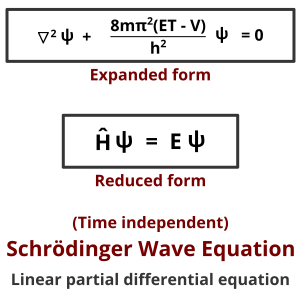
Perturbation theory is an approximation method to find the exact solution of a complex quantum system for which the Schrodinger wave equation (SWE) can’t be applied. However, (SWE) is applied to the particular system to find exact solutions such as a particle in a 1-D box, rigid rotor, harmonic oscillator, and a hydrogen atom. When the Schrodinger wave equation is applied to this system we get the exact solution.
But most systems cannot be solved exactly, for instance, helium atom, Anharmonic oscillator, and non-rigid rotor. Because these are all multi-electron systems while the SWE can only be applied to uni-electron systems.
To solve the complex quantum system we use the approximation method. There are two types of Approximation methods:
- Perturbation method
- Variational method
Here we discuss the Perturbation method.
Perturbation theory in chemistry
The term perturbation means ‘disturbance’. In quantum chemistry, perturbation means there is a disturbance in a system or deviation from the actual value. In simple terms, we call it an ‘error’.which is the difference between the actual value and the experimental value. Similarly, Perturbation is the difference between perturbed terms and un-perturbed terms.
Consider the system for which the Schrodinger wave equation cannot be used to find the value of energy. To find the value of energy we use the perturbation method.
As the Schrodinger wave equation is given by:
HΨ=EΨ → (1)
This is a perturbed system whose solution is unknown
Consider another system whose solution is known;
HoΨo=EoΨo → (2)
This is an unperturbed system
Perturbation in a system is given below:
ΔH= Perturbed-Unperturbed
ΔH= H-Ho
H=ΔH+Ho → (3)
Perturbation in energy is given by:
ΔE= E-Eo
E=ΔE+Eo → (4)
Similarly, perturbation in wave function is:
ΔΨ= Ψ-Ψo
Ψ=ΔΨ+Ψo → (5)
put eq(3), (4) and (5) in equation (1)
(ΔH+Ho)(ΔΨ+Ψo)=(ΔE+Eo)(ΔΨ+Ψo)
open the bracket by multiplying
ΔHΔΨ+ΔHΨo+HoΔΨ+HoΨo= ΔEΔΨ+ΔEΨo+EoΔΨ+EoΨo
As from eq (2) is;
HoΨo=EoΨo
so cancel these terms from both sides
ΔHΔΨ+ΔHΨo+HoΔΨ=ΔEΔΨ+ΔEΨo+EoΔΨ
As ‘Δ’ is very small and the product of two Δ is very very small so neglect these terms such as ΔHΔΨ and ΔEΔΨ
ΔHΨo+HoΔΨ=ΔEΨo+EoΔΨ
By re-arranging the equation:
ΔEΨo=ΔHΨo+HoΔΨ-EoΔΨ
ΔEΨo=ΔHΨo+(Ho-Eo)ΔΨ
Multiply both sides by Ψ(o)* and integrate
ΔEΨoΨ(o)* dτ=
ΔHΨoΨ(o)* dτ+
(Ho-Eo)ΔΨΨ(o)*dτ
where Ψ(o)* is the conjugate of Ψ(o)
ΔEΨoΨ(o)* dτ=
ΔHΨoΨ(o)* dτ+
(Ho-Eo)ΔΨΨ(o)*dτ
As for normalized function
ΨoΨ(o)* dτ=1
so the above equation becomes
ΔE=ΔHΨoΨ(o)* dτ+
(Ho-Eo)ΔΨΨ(o)*dτ
ΔE=ΔHΨoΨ(o)* dτ+I1 → Eq (6)
where:
I1=(Ho-Eo)ΔΨΨ(o)*dτ
As Hermition operator satisfy
Ψ* HΨdτ=
Ψ HΨ*dτ
so,
I1=Ψ(o)*(Ho-Eo)ΔΨdτ
All quantum mechanical operator is hermitian so (Ho-Eo) is also hermitian and satisfy the condition
I1=ΔΨ(Ho-Eo)Ψ(o)*dτ
I1=ΔΨ(HoΨ(o)*-EoΨ(o)*)dτ
Since HoΨ(o)=EoΨ(o) so HoΨ(o)*-EoΨ(o)*=0
and I1=0
put in eq (6), we get
ΔE=ΔHΨoΨ(o)* dτ
This is the value of perturbation energy
put this value in eq (4)
E=ΔE+Eº
E=ΔHΨºΨ(º)* dτ+Eº
where:
- E= perturbed energy
- Eº= un-perturbed energy
ΔHΨºΨ(º)*= perturbation in energy
Example of Perturbation theory
Example of an Anharmonic Oscillator
Schrodinger wave equation can be applicable to the Harmonic oscillator to give an exact solution. But in the case of an Anharmonic oscillator, there is an additional term present which we call the perturbed term.
In the case of a harmonic oscillator, we assume that x is very small so when we apply Taylor expansion on P.E it gives only
P.E=
But in Anharmonic Oscillator, the higher term cannot be neglected and it is equal to
V(x)=
Hamaltonian operator is
H= K.E+P.E
H=
1st Term
This is a Hamiltonian operator for harmonic oscillator on which the Schrodinger wave equation is applicable and give an exact solution. It is denoted by H(o) and called the unperturbed Hamiltonian.
2nd Term
This is an additional term whose presence prevents an exact solution. SWE cannot be applied to give an exact solution. This is called perturbation term. It is denoted by H(1).
so
H=H(o)+H(1)
Example of the Hydrogen atom
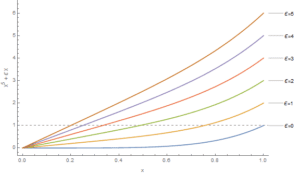
When a hydrogen atom is placed in the electric field of strength ε. The Hamiltonian operator is given by:
H= –
The above expression is the sum of the unperturbed and perturbed terms.
Example of Rigid Rotor
For rigid rotor with dipole moment μ in an electric field of strength ε.
H=
This is also the sum of the unperturbed and perturbed terms.
Concepts Berg
What is the purpose of perturbation theory?
Perturbation theory is an important tool for describing the complex quantum system. Perturbation theory is applicable when an exact solution to any problem is not known.
What is a perturbation in physics?
Perturbation means disturbance in a system or motion produced by some external force. When a body undergoes a change in motion due to external force then the difference between actual motion and the change in motion of the body is called perturbation.
What is an example of perturbation?
An example of perturbation in real life is the trajectory of the moon which is under the control of the gravitational force of both the earth and the sun. Hence the path cannot be properly estimated. so perturbation is used.
How do you solve perturbation?
The Perturbation solution is obtained by breaking the series and keeping the first two terms, the solution of the known problem, and first-order perturbation correction.
What is the difference between perturbation and disturbance?
Both the terms perturbation and disturbance are synonyms. Disturbance means disruption or stirring something. While perturbation means excessive disturbance in a system or disturbance beyond the normal level.
Who introduced perturbation theory?
In 1927 Paul Dirac develop the perturbation theory.
What is image perturbation?
Image perturbation means setting the image by changing its position, i.e vertically or horizontally. It also means that improve the quality of the image by applying an image enhancement operator.
What is a perturbation in biology?
In biology, the term perturbation means that change in the function of a biological system due to internal or external factors such as environmental change or gene knockdown.
References
- Time-independent Perturbation theory ( Massachusetts Institute of Technology)